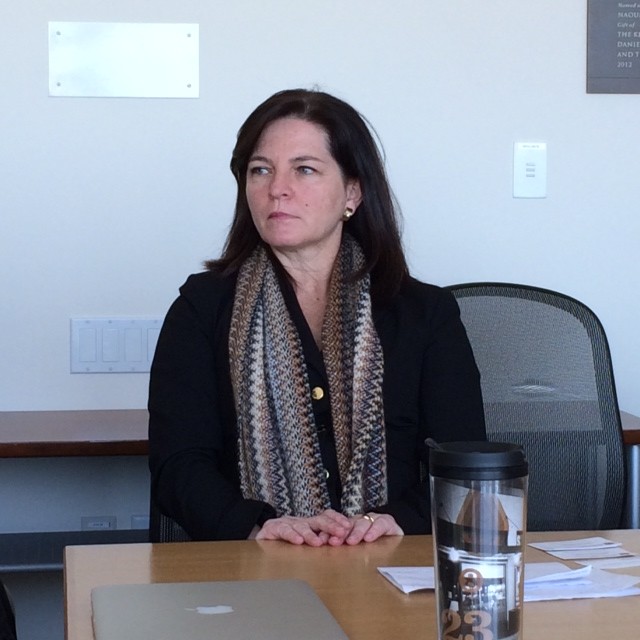
 Raquel Dodge, Deputy Assistant Attorney General at the Federal Public Prosecutor’s Office (Ministério Público Federal – MPF) in Brazil, spoke on Jan. 13, 2014, about the institutional experience of prosecuting former officials for crimes committed during the Brazilian dictatorship.
On Dec. 14, 2010, the Inter-American Court of Human Rights handed down a landmark decision in Gomes Lund v. Brazil. The Court acknowledged the Brazilian state liability for the forced disappearance of rebels during the insurrection known as Guerrilha do Araguaia, and for the violation of their rights to life, personal integrity, freedom of thought and expression, and to due process of law.
The Court ruled that the amnesty laws that prevented the prosecution of military officials were incompatible with the Inter-American Convention of Human Rights and, as a result, Brazilian public institutions should investigate the crimes committed during the dictatorship.
Raquel Dodge spoke about the Federal Public Prosecutor’s Office strategy to enforce the Gomes Lund decision, by investigating and prosecuting former officials. By the time of the ruling, the MPF was already adopting some institutional measures to give effect to Human Rights. In this sense, an important stage was the structuring of specialised groups to deal with issue such as corruption, health, education, the administration of federal roads, procedural issues related to criminal law, institutional reforms and crimes committed against minorities and vulnerable persons.
After Gomes Lund’s ruling, the MPF had to cope with a peculiar situation. By that time, the Brazilian Supreme Court had already ruled that the amnesty law of 1979 was constitutional and, as a consequence, officials could not be prosecuted for crimes committed during the dictatorship. In order to avoid legal obstacles resulting from the Supreme Court’s precedent, the MPF decided to prosecute only crimes qualified as permanent, which had begun during the dictatorship but continued to be committed after 1979, such as kidnapping and concealment of body. So far, no judicial trials have been definitely decided yet.
//
//
//