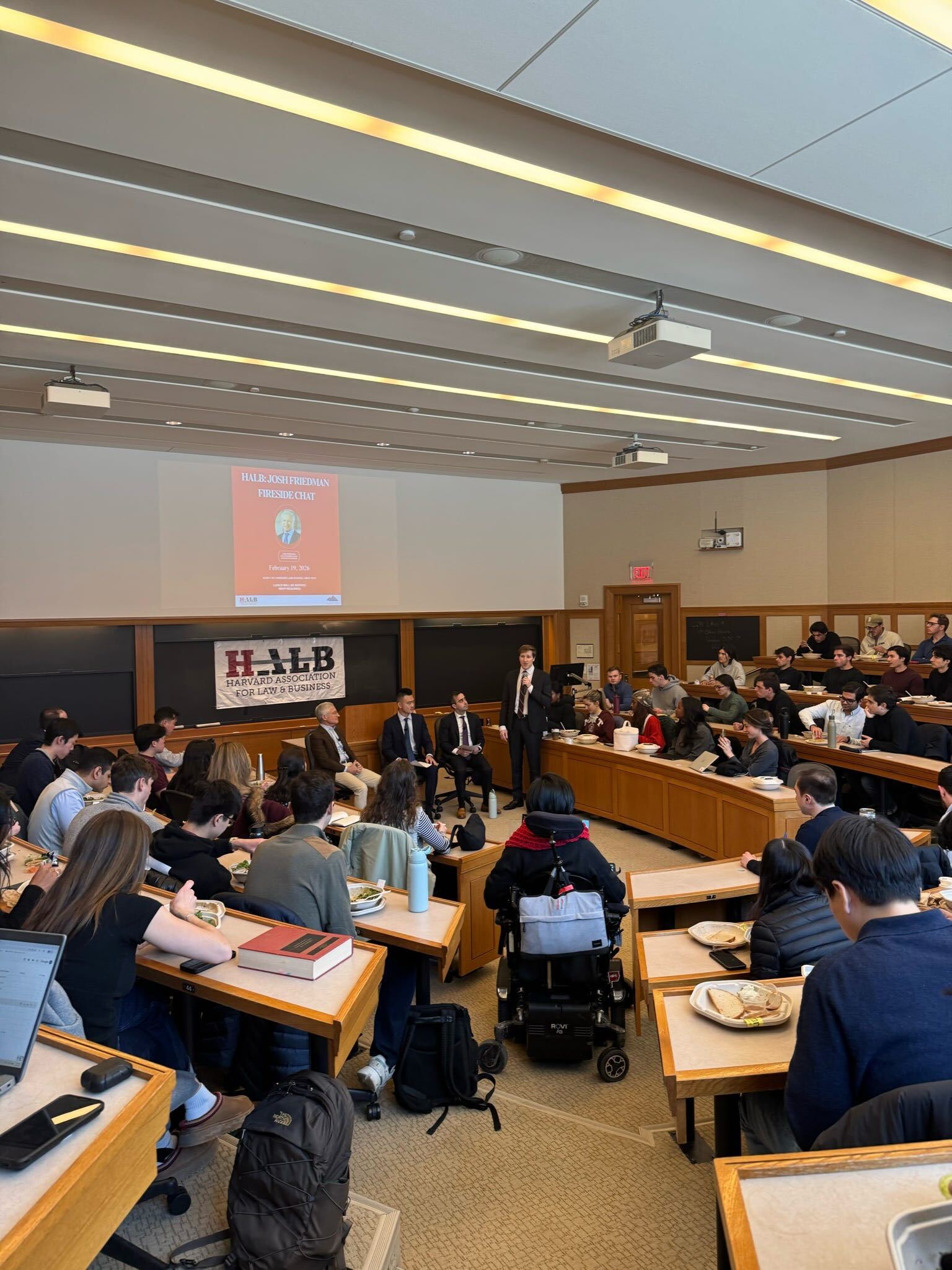
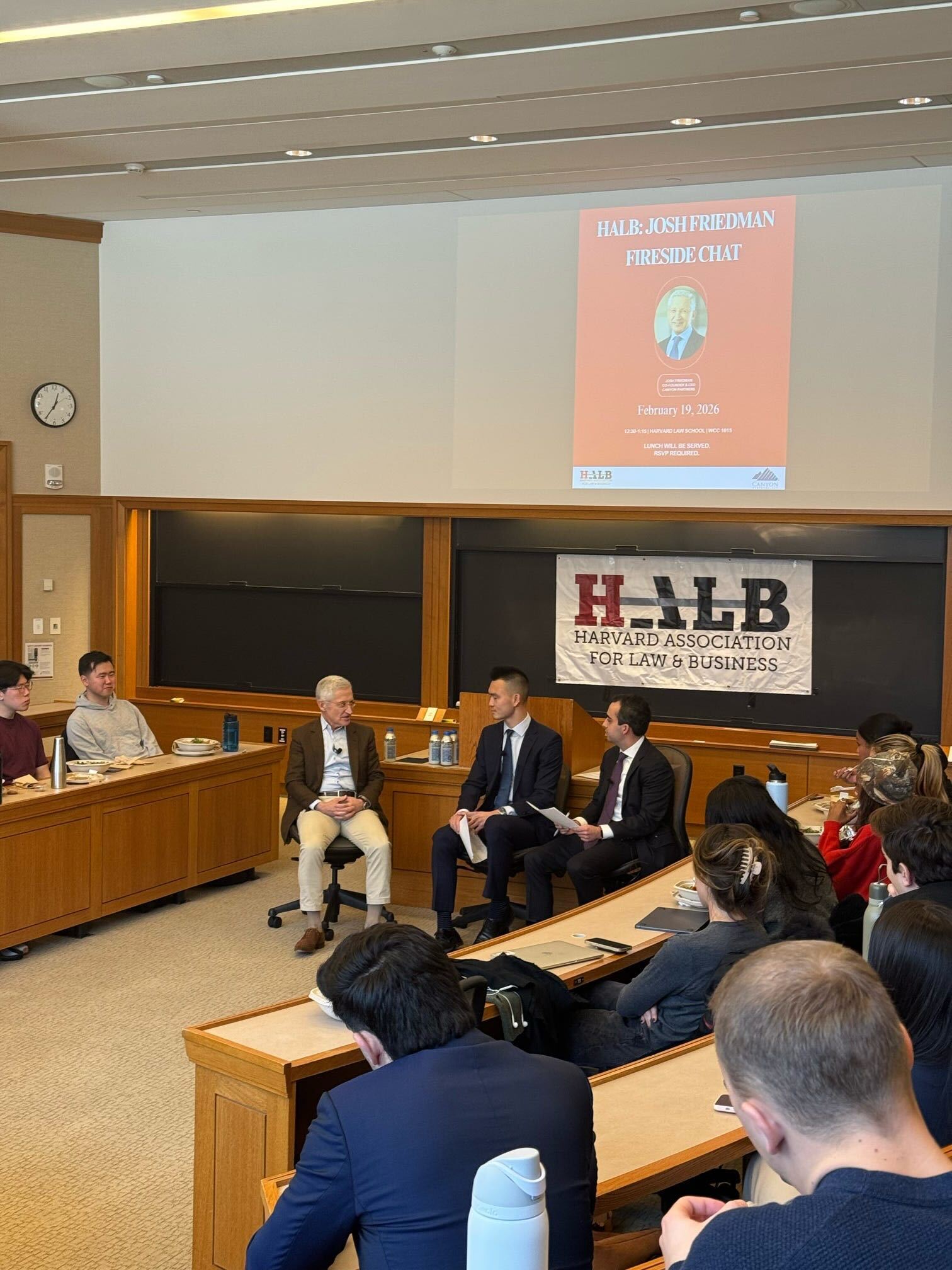
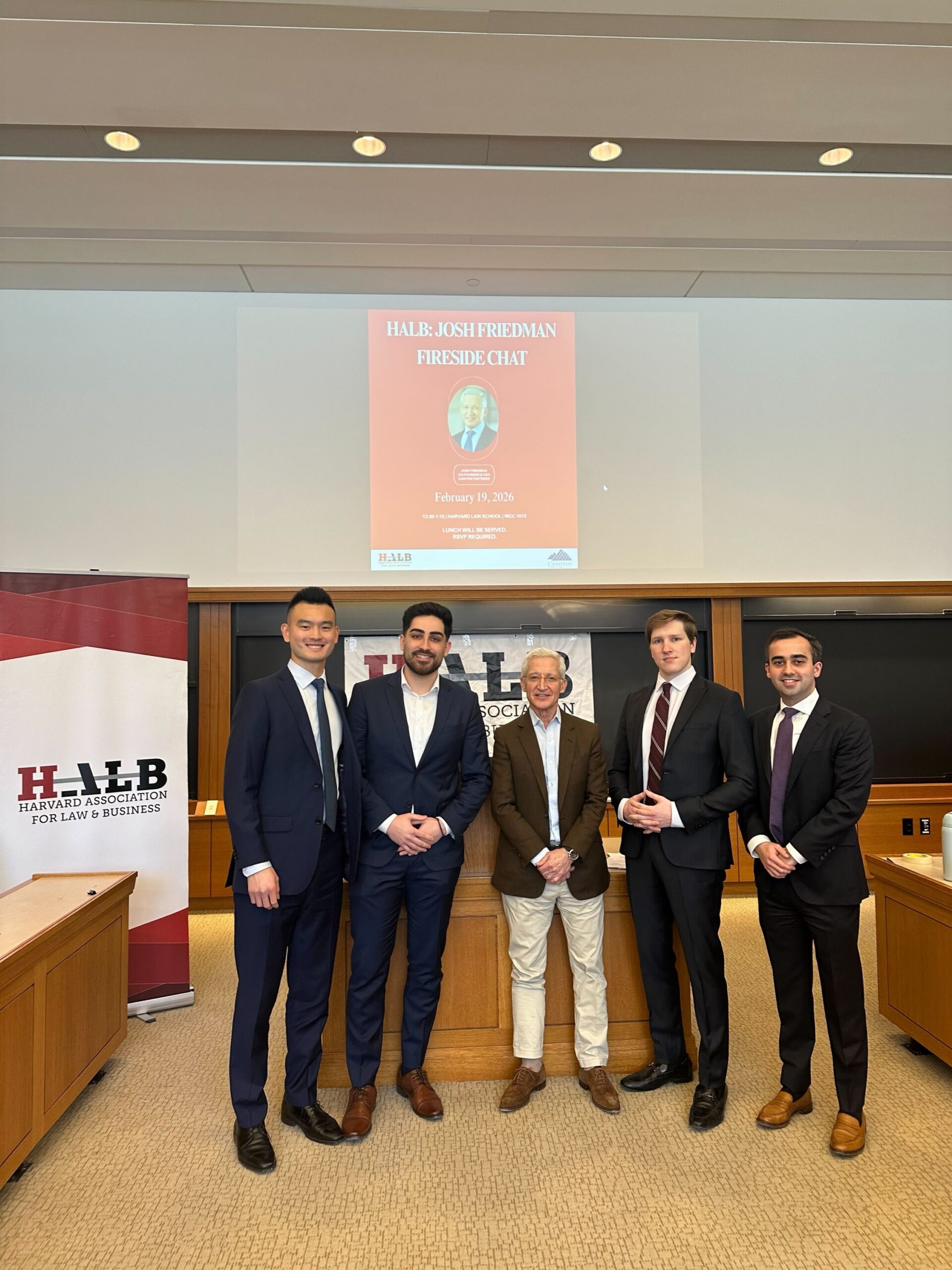
HALB presents a conversation with Josh Friedman, Co-Founder, Co-Chairman, and Co-CEO of Canyon Partners, LLC
Please find a recording of the HALB conversation with Mr. Friedman linked here.
HALB presents a conversation with Stephen Schwarzman, chairman, CEO and co-founder of the Blackstone Group
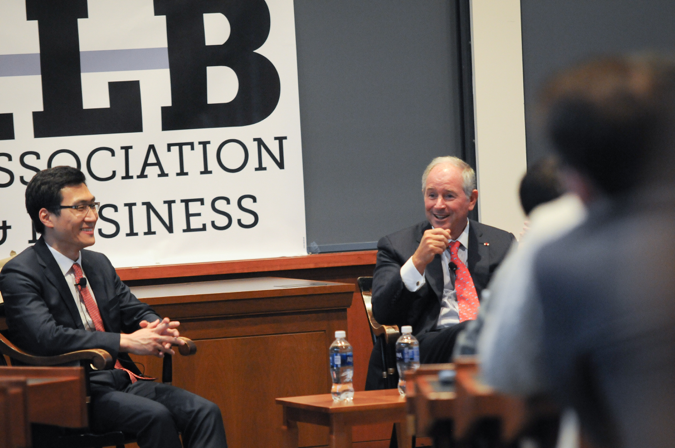
The Harvard Association for Law and Business (HALB) hosted Stephen A. Schwarzman, chairman, CEO and co-founder of the Blackstone Group — the largest alternative asset management firm in the world — to discuss lessons from his long career in business, and his many years of work as a philanthropist. Jeff Cui JD/MBA ’17 moderated the discussion, which ranged from Schwarzman’s early professional career to his current position as chairman of the President’s Strategic and Policy Forum, a roundtable of business executives formed in December 2016 to provide insights to the new administration as it implements its economic agenda.
Dean Martha Minow kicked off the event by welcoming Schwarzman, calling him “a leader in every sense of the word,” and thanking HALB for inviting him to the law school as part of their series of fireside chats, held throughout the academic year. In his introduction, Cui said that Schwarzman is not only a corporate titan but also a game changer in the public sector — both in the U.S. and on the world stage. “HALB board members believe Steve embodies our mission of educating students with an interest at the intersection of law and business,” he said.
Schwarzman opened the forum by discussing his early professional career, and attributed part of his success to an “ability to operate under conditions of complete fear.” He recalled entering the boardroom of Tropicana as a young Lehman Brothers banker in 1977, having been specifically recruited to advise on and close a $488 million merger deal despite his relative inexperience. After closing the deal, Schwarzman asked the President of Tropicana why he was chosen as the lead banker. “I asked ‘Why me?’ And he said, ‘Because you have the ability to make complicated things simple.’”
40 years later, Schwarzman is staying true to his belief in extracting simple logical conclusions from the world’s noisy data. Every Monday morning, Blackstone connects its global offices by videoconference to discuss the latest trends. “For us to do well, we have to know what the cyclical and geopolitical forces are,” Schwarzman emphasized, noting that the meetings also allow junior associates at the firm to participate in an open discussion about the critical drivers that affect the market. “Investing isn’t that different from playing hockey, as described by the great Wayne Gretzky,” Schwarzman said. “You need to ‘skate to where the puck is going’ to be in the right place at the right time.”
Schwarzman uses that ability to anticipate the future to stay one step ahead of the competition. He entered the fields of M&A and private equity when they were still emerging, and he and his firm make investment decisions based on similar themes. For instance, in the early years of internet shopping, Blackstone realized that the logistics sector was on the rise, and that e-commerce companies’ needs for warehouses near major cities would eventually skyrocket. “We had an intellectual construct, a point of view, that the rent will explode when Amazon gets to town and needs warehouse space,” Schwarzman said. Unsurprisingly, Blackstone has since been able to sell this portfolio at attractive prices. The firm’s rigorous process and aggregate investment acumen enables it to play out market trends while limiting much of the usual risk inherent in making investment decisions.
Schwarzman acknowledged that foresight and talent alone did not bring his success. They were supported by his strong work ethic. “The standard for professionalism is 100%,” Schwarzman emphasized, “You cannot make mistakes.” Cui, the moderator, noted that between meetings, Schwarzman fully utilized his time. “After a long day of back-to-back meetings, Steve was on his way to the airport,” Cui recalled. “The first thing he did after getting in the car was to turn on his computer. I was beyond impressed. This showed me how disciplined and hardworking Steve was even at his level.”
One of Schwarzman’s more recent areas of focus is his Schwarzman Scholars program. Described as the “first scholarship created to respond to the geopolitical landscape of the 21st century,” the program hosts up to 200 students for a one-year Master’s Degree at Tsinghua University in Beijing.
Schwarzman’s interest in China started when he visited the country in 1990 and later witnessed its fast growth. In 2007, when China Investment Corporation bought into the Blackstone IPO with approximately $3 billion, many critics argued that Blackstone should stop the deal. “I got this shock that there were very strong attitudes toward China.” Schwarzman cited the Thucydides Trap, a Greek metaphor describing that, when a rising power challenges an incumbent, the tension often escalates to a war despite both sides’ reluctance. The Schwarzman Scholars program is his effort to help stop history from repeating itself. “If the scholars developed into thought leaders, they would become a layer of protection against this Thucydides Trap,” Schwarzman noted.
Schwarzman’s dedication to public service led him to take the position as the Chairman of President’s Strategic and Policy Forum. The Forum includes some of the country’s top CEOs and business leaders and creates an environment where they can provide candid insight to the Trump administration on economic matters. “The basic substance of what they are trying to do,” Schwarzman said referring to the current administration, “is to create the preconditions for dramatically increasing growth.” He believes that lowering tax and increasing employment rate are the outcomes that everyone in the U.S. will benefit from. “The question is, can you accomplish that?” During his chairmanship of the Forum, Schwarzman will facilitate the sharing of its members’ views to President Trump through a non-bureaucratic exchange of ideas.
After the event, Cui noted that Schwarzman’s vision, courage, and tenacity left a strong impression on him. “Steve’s intellectual capacity is simply staggering. Sitting next to him, I could vividly sense his innate craving to be the best at whatever he did and a personal appreciation for those who share a similar thirst for excellence.”
The event was organized by the Harvard Association for Law and Business under the leadership of Co-presidents Kisho Watanabe and Daniel Wertman, Executive Vice Presidents David Kafafian and Jianjian Ye, Vice President Brooke Stanley, Symposium Chair Loren Shokes, Private Equity and Venture Capital Chair Jeff Cui, and HALB photographer Jerry Ting.
HALB presents a conversation with Bill Ackman, founder and CEO of Pershing Square Capital Management
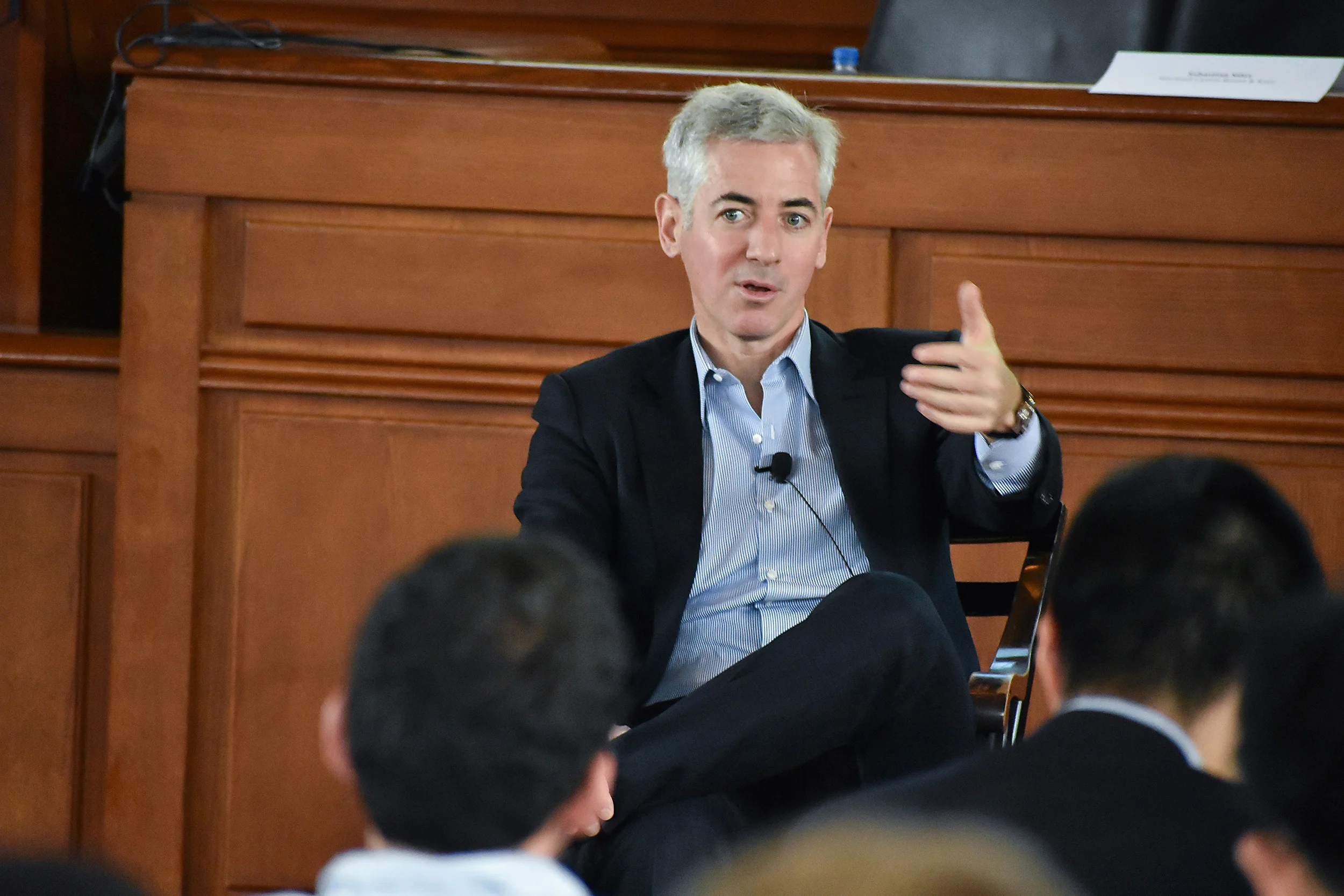
The Harvard Association for Law and Business (HALB) hosted Bill Ackman, founder and chief executive officer of Pershing Square Capital Management on April 12, to discuss his views on the current state of activist investing, his experience managing a multibillion dollar fund, and the impact of shareholder activism on corporate governance. Professor Charles C. Y. Wang, Glenn and Mary Jane Creamer Associate Professor of the Harvard Business School, moderated the discussion.
The event was part of HALB’s inaugural Harvard Law School Activism Roundtable. “The core mission of HALB is to create a platform to discuss key issues at the intersection of law and business, such as shareholder activism,” said Jianjian Ye ’18, HALB co-president. “Establishing the Harvard Law School Activism Roundtable and bringing in business leaders like Bill demonstrates our commitment to this mission.”
Professor Wang opened up the discussion by situating Ackman’s position within the larger debate on shareholder activism. Quoting Martin Lipton, founding partner of Wachtell, Lipton, Rosen & Katz, which specializes in advising major corporations on mergers and acquisitions, Wang raised Lipton’s criticism that activism “has been a major driver of short-termism, reduces long-term sustainable investments . . . promotes inequality and strikes at the very heart of our society.” In response, Ackman acknowledged the existence of an entire spectrum of activism. However, he argued that activists are not buying control of a company, but only a seat at the table. Ultimately, in Ackman’s view, the board of directors makes the short-term decisions, not the activist investors.
Ackman continued by explaining why activism is good for corporations. Activism “has materially shifted the balance of power,” he noted, explaining that America’s directorship system has not been updated since the days of the Carnegies and Vanderbilts. Now, however, American corporations have diversified owners, including many index funds. Indexing particularly has democratized corporate ownership to a great degree, Ackman said, where investors big and small can participate in the financial market for a minimal fee.
Ackman argued that based on this democratized shareholder basis, the way the directors are chosen and make decisions should be more democratized as well. In this sense, Ackman said, shareholder activism means more accountability and motivation for directors “to act in the best interest of the company, shareholders, and all stakeholders.”
When asked about the rise of passive investment, Ackman sounded a word of caution against the negative effects that passive asset managers might bring to corporations. Although passive asset managers have been very vocal about the fact that they consider themselves permanent shareholders, Ackman said that he was concerned about their impacts on corporate governance. He argued that the incentive structures are built such that passive asset managers are not overly concerned about any one part of their large portfolios.
Ackman wrapped up the talk by giving his word of advice to the Harvard students in the audience: “People get themselves on a treadmill, and one of your biggest mistakes is that you have not made a mistake.” He encouraged students to focus on how to handle adversity, not how to avoid it.
After the event, Ndu Okereke ’18, the activism chair of HALB, said: “Regardless of which side of the shareholder activism debate one sits on, it is clear that activism has had a substantial impact on corporate governance and will continue to play a role. As a result, the dialogue is one that should be constructive and ongoing, whether in academic settings, corporate board rooms, shareholder investment committees or otherwise.”
This year, the Harvard Law School Activism Roundtable series has featured talks with Brad Singer, partner and COO of ValueAct Capital; Munib Islam, partner and executive team member at Third Point Management; Sabastian Niles, partner at Wachtell Lipton Rosen & Katz; Eleazer Klein, partner at Schulte Roth & Zabel; and Samuel Flax, former executive vice president and general counsel at American Capital.
The Harvard Law School Activism Roundtable was organized by the Harvard Association for Law and Business under the leadership of Co-Presidents Jianjian Ye ’18 and David Kafafian ’18, Activism Chair Ndu Okereke ’18, and Executive Vice Presidents Elizabeth Ferrie ’19 and Heather Lee ’19.
HALB Private Equity Roundtable: David M. Rubenstein of The Carlyle Group
David M. Rubenstein, Co-Founder and Co-Executive Chairman of The Carlyle Group, spoke last Wednesday as the keynote speaker in a moderated fireside chat with Heather Lee JD ’19 at Harvard Law School. He discussed the co-founding of The Carlyle Group—one of the world’s largest and most successful investment firms with $216 billion of assets under management—and his views on philanthropy.
The keynote discussion was part of the Harvard Association for Law and Business (HALB) Private Equity Roundtable.
“HALB has strived to connect students with the leaders of the law and business worlds since its foundation in 2005,” said Lee, HALB Co-President. “This year’s Private Equity Roundtable was a key initiative to bolster our mission by allowing students to hear from leaders like Mr. Rubenstein, whose influence spans across law, business, and philanthropy.”
Professor Vladimir Bosiljevac, the Bruce W. Nicholas Lecturer on Law who teaches courses on private equity at Harvard Law School, introduced Mr. Rubenstein by noting his extensive philanthropic contributions to educational institutions, medical research centers, and arts and culture non-profit organizations, coined “Patriotic Philanthropy.”
The event opened with questions from Lee about Mr. Rubenstein’s youth. As the only child of parents without a high school education and a father earning a modest sum as a postal worker, Mr. Rubenstein realized early the need to learn and absorb.
“One of the great advantages in my life was that I grew up with no money,” he said. “You get a sense that if you want to do anything in the world, you have to do it on your own.”
After winning a scholarship to Duke University and The University of Chicago Law School where Mr. Rubenstein was the editor of The Law Review, he began practicing law at Paul, Weiss under partner Ted Sorensen who famously drafted John F. Kennedy’s inaugural address. But Mr. Rubenstein quickly realized that he didn’t enjoy the work as an attorney.
“People said to me, you’re not that good at being a lawyer,” said Mr. Rubenstein. “My client said to me, you’re really not cut out for this, maybe you should try something else.”
Sorensen introduced Mr. Rubenstein to Jimmy Carter’s presidential campaign team, and he followed Carter into the White House, becoming the Deputy Assistant to the President for Domestic Policy. Known for his Herculean work ethic at the White House, Mr. Rubenstein arrived first, left last, and made meals of vending machine snacks.
“I had no interest in making money, only in giving back to the country,” Mr. Rubenstein said.
When Carter lost to Ronald Reagan, Mr. Rubenstein returned to practicing law and confirmed his lack of passion for the legal practice. With his motivation low, Mr. Rubenstein came across an article describing an early leveraged buyout transaction by William Simon, a former U.S. Treasury Secretary who was a pioneer of the practice of buying companies with significant amounts of debt and selling them for a profit.
Spurred by another article reporting that entrepreneurs start companies between the ages of 28 and 37, 37-year-old Rubenstein began looking for partners in Washington, D.C. to start a leveraged buyout firm. With no finance experience and competing against established New York players, Mr. Rubenstein turned to creative marketing.
“If you are getting kicked out of town, get out in front and pretend you are leading a parade,” said Mr. Rubenstein, quoting Everett Dirksen, former Senate Minority Leader in 1959. “It means take advantage of the situation.”
He recruited three others—William Conway, Daniel D’Aniello, and Stephen Norris—and founded The Carlyle Group in 1987. The team distinguished their expertise from firms in New York by touting an understanding of companies affected by the federal government.
After a few high-profile transactions, including the $130 million buyout of BDM International Inc., and recruiting Washington insiders, George H.W. Bush, Jim Baker, Frank Carlucci and others, the group began reinventing the leveraged buyout model.
While early partnership agreements required general partners to manage single funds, Mr. Rubenstein convinced his co-founders to create multiple funds dedicated to differentiated strategies—growth capital, buyout, venture, real estate, distressed debt, and others. This approach capitalized on Carlyle’s growing credibility as a brand and centralized legal, tax, and accounting services across funds.
“It was a model that hadn’t happened before in private equity,” said Mr. Rubenstein, “I had to go out and raise money for the funds perpetually.”
Mr. Rubenstein ultimately built an international fundraising team to constantly raise money.
“The sun never sets on a Carlyle fundraising effort,” he said.
On philanthropy, Mr. Rubenstein noted that his focus has centered on gifts that are “patriotic.” Continuing his lifelong goal to serve his country, Mr. Rubenstein has donated significant amounts to the repairs of the Washington Monument, Monticello, and many other historic landmarks. He has also made publicly available his collections of the Magna Carta, the Declaration of Independence, the Thirteenth Amendment, and many other historical documents.
“I’m trying to remind people about our history on the theory that, if they learn more about history, we won’t repeat some of the mistakes that we’ve made in the past,” Mr. Rubenstein explained.
Speaking to the crowd, Mr. Rubenstein urged students to be deliberate in how they spend their future wealth. He was an original signer of the Giving Pledge, committing to donate a majority of his wealth to philanthropy.
“Learn how to use the money that you are going to make, have a reasonable purpose, and do something useful with it,” said Mr. Rubenstein.
“It was wonderful to welcome David M. Rubenstein at Harvard Law and hear him speak about the founding and growth of Carlyle, as well as his approach to philanthropy,” said Joe Kurtenbach, JD/MBA ’20 and the private equity chair of HALB. “This was a terrific opportunity for law students to learn about the private equity industry from one of the leaders who helped shape it.”
This year, the Private Equity Roundtable has also featured a panel on the State of Private Equity with A.J. Murphy (Managing Director of Silver Lake), Daniel Brand (Senior Managing Director of CVC), Eric Lee (General Partner of Welsh, Carson, Anderson & Stowe), Adam Nebesar (Managing Director of Bain Capital), and Kristin Steen (Managing Director of CCMP Capital). The Roundtable was generously sponsored by Kirkland & Ellis LLP.
The Private Equity Roundtable was organized by the Harvard Association for Law and Business (HALB) under the leadership of Heather Lee ’19, Eric Lim ’20, Nancy Zhu ’20, Joseph Yim ’20, Joe Kurtenbach JD/MBA ’20, Caroline Zhang ’21, Alex Yang ’21, and Amy Aixi Zhang ’20.